
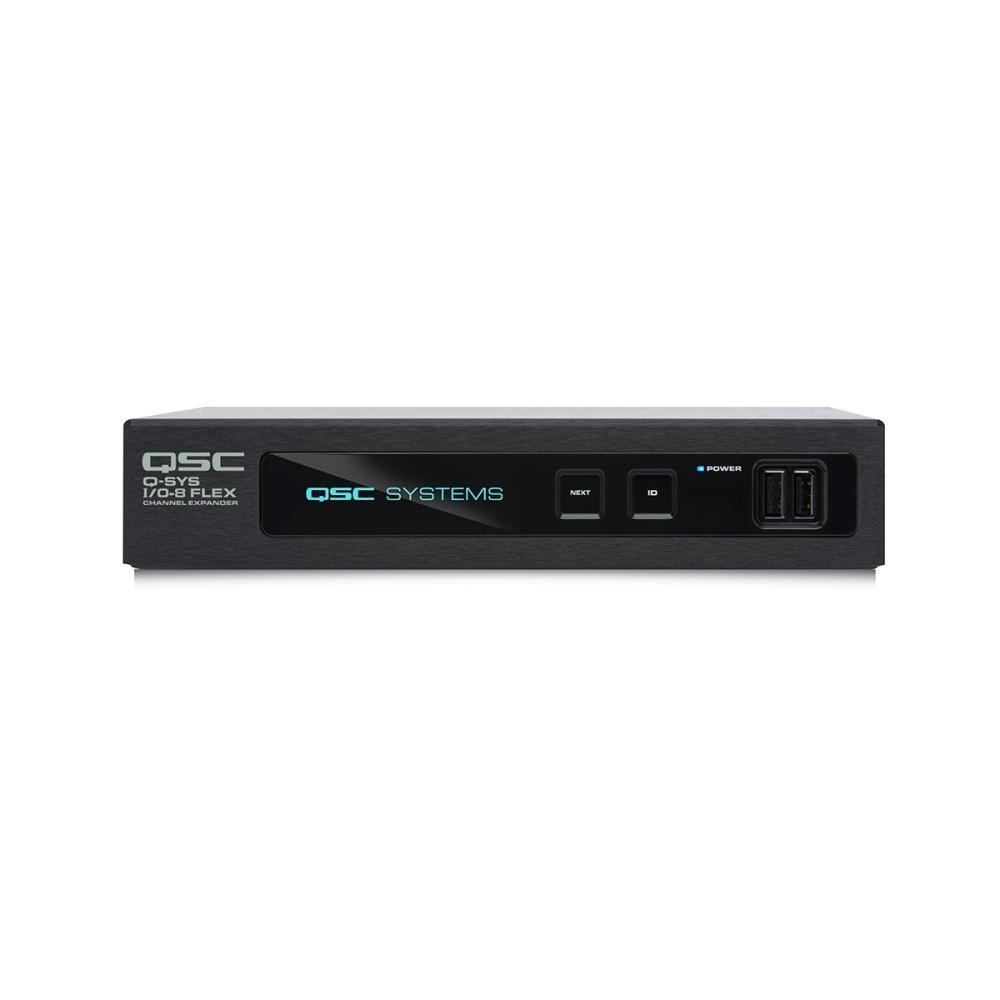
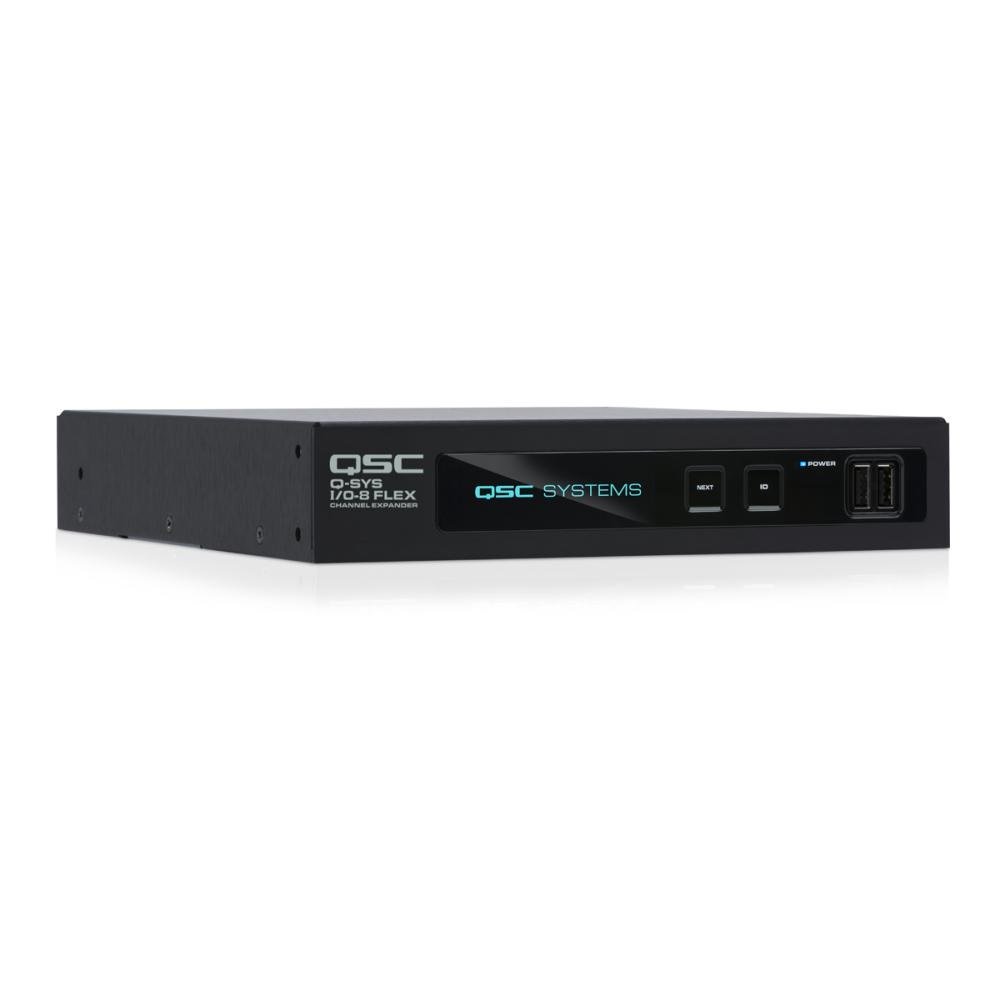



Q-SYS I/O-8 Flex Network Audio Interface
Upgrade your professional AV infrastructure with the highly flexible and powerful Q-SYS I/O-8 Flex Network Audio Interface, an advanced 8-channel audio expansion solution designed to seamlessly integrate with the Q-SYS ecosystem. Built for modern networked audio environments, this versatile interface delivers exceptional performance, scalability, and reliability for a wide range of professional AV applications including corporate spaces, education facilities, hospitality venues, and large-scale commercial installations.
The Q-SYS I/O-8 Flex Network Audio Interface is engineered to provide unmatched flexibility in audio connectivity. With eight configurable Flex channels, users can dynamically assign each channel as either a microphone input or a line-level input. This adaptability makes it an ideal choice for system integrators who require a single device capable of handling multiple audio sources without the need for additional hardware. Whether you are connecting microphones, mixers, or external audio devices, the I/O-8 Flex ensures seamless integration and superior audio quality.
At the core of the Q-SYS I/O-8 Flex Network Audio Interface is the robust Q-SYS platform, a cloud-manageable AV ecosystem that combines hardware and software for centralized control and monitoring. The I/O-8 Flex connects directly to a Q-SYS Core processor over a standard network, enabling real-time audio routing, processing, and system management. This network-based architecture reduces the need for complex wiring, simplifies installation, and enhances system scalability.
The Q-SYS I/O-8 Flex Network Audio Interface features high-quality preamps designed to deliver clean, low-noise audio signals. This ensures excellent clarity and accuracy, even in demanding environments where audio quality is critical. Phantom power support is available for condenser microphones, further expanding the range of compatible audio sources.
One of the standout advantages of the Q-SYS I/O-8 Flex Network Audio Interface is its compact and rugged design. The device can be easily mounted under tables, in racks, or within ceilings, making it suitable for discreet installations. Its durable construction ensures long-term reliability, even in high-traffic or mission-critical environments.
Power over Ethernet (PoE) capability simplifies deployment by allowing both power and data to be delivered over a single network cable. This reduces installation time and cost while improving overall system efficiency. Additionally, the Q-SYS I/O-8 Flex Network Audio Interface supports redundant network configurations, ensuring uninterrupted operation in critical applications.
The Q-SYS I/O-8 Flex Network Audio Interface is also designed with advanced monitoring and diagnostics features. Integrators can remotely monitor device status, signal levels, and performance through the Q-SYS Designer software. This proactive approach to system management helps identify and resolve issues quickly, minimizing downtime and ensuring optimal performance.
Customization is another key strength of this interface. Using Q-SYS Designer, users can configure each channel to meet specific project requirements, create custom control interfaces, and integrate with third-party systems. This level of flexibility makes the Q-SYS I/O-8 Flex Network Audio Interface suitable for a wide range of applications, from simple audio input expansion to complex, multi-zone AV systems.
From boardrooms and classrooms to auditoriums and hospitality venues, the Q-SYS I/O-8 Flex Network Audio Interface delivers consistent and high-quality audio performance. Its combination of flexible channel configuration, network-based integration, and reliable operation makes it a valuable addition to any professional AV system.
In conclusion, the Q-SYS I/O-8 Flex Network Audio Interface is a powerful, scalable, and future-ready solution for expanding audio input capabilities in modern AV installations. With its intelligent design, superior audio performance, and seamless integration with the Q-SYS ecosystem, it provides unmatched flexibility and efficiency for professional audio applications.
Explore our full range of Audio Interfaces
Features
- 64 x 64 networked audio channels (Q-LAN / AES67)
- Eight on-board Flex channels and GPIO
- 8 x AEC (acoustic echo cancellation) processors
- up to 32 x 32 Dante audio channels (8 x 8 included)
- Supports up to three (3) Q-SYS NM-T1 tabletop microphones (up to six (6) with the Collaboration
Bundle scaling license) - USB AV bridging (8 x 8 audio + Q-SYS camera support)
- External USB audio device host
- Supports up to 2 VoIP softphone instances
- Full featured Q-SYS Control engine
- Dual gigabit ethernet ports with assignable application resources offering any combination of VoIP, Q-LAN Control, Q-LAN audio or network redundancy
- Internal power supply
- 1U half-width, includes mounting hardware
Specifications
| Specification | Details |
|---|---|
| Model | Q-SYS I/O-8 Flex |
Processing & Network Audio
| Category | Specification | Details |
|---|---|---|
| Processor | Architecture | Intel 64-bit |
| Audio Processing | Internal Processing | 32-bit floating point |
| Q-LAN Transport | Network Audio | 32-bit floating point |
Audio Inputs
| Category | Specification | Details |
|---|---|---|
| Power | Phantom Power | +48 VDC, 10 mA per input (max) |
| Conversion | A/D – D/A | 24-bit |
| Sample Rate | 48 kHz | |
| Frequency Response | 20 Hz – 20 kHz @ +24 dBu (+0.5 / -0.5 dB) |
Input Performance
| Specification | Details |
|---|---|
| THD+N @ 1 kHz | <0.1% (@ +24 dBu sensitivity & +24 dBu input) |
| <0.0015% (@ +24 dBu sensitivity & +10 dBu input) | |
| <0.001% (@ +10 dBu sensitivity & +8 dBu input) | |
| <0.001% (@ -10 dBu sensitivity & -10.5 dBu input) | |
| <0.007% (@ -39 dBu sensitivity & -39.5 dBu input) |
Crosstalk & Dynamic Range
| Specification | Details |
|---|---|
| Input Crosstalk @ 1 kHz | 110 dB typical (@ +24 dBu), 90 dB max |
| 105 dB typical (@ +10 dBu), 90 dB max | |
| 100 dB typical (@ -10 dBu), 90 dB max | |
| 75 dB typical (@ -39 dBu) | |
| Dynamic Range | >109.5 dB (@ +24 dBu) |
| >106.4 dB (@ +10 dBu) |
Common Mode Noise Rejection (CMRR)
| Sensitivity | 20 Hz–3 kHz | 20 Hz–10 kHz | 20 Hz–20 kHz |
|---|---|---|---|
| +24 dBu | <51 dB | <43 dB | <36 dB |
| +10 dBu | <57 dB | <47 dB | <41 dB |
| -10 dBu | <67 dB | <58 dB | <53 dB |
| -39 dBu | <60 dB | <54 dB | <50 dB |
Input Characteristics
| Specification | Details |
|---|---|
| Input Impedance | 7.2 kΩ (balanced, nominal) |
| Sensitivity Range | -39 dBu to +24 dBu (1 dB steps) |
Audio Outputs
| Category | Specification | Details |
|---|---|---|
| Frequency Response | 20 Hz – 20 kHz (+0.5 / -0.3 dB) | |
| THD | 0.005% typical | |
| Max Output Level | +20 dBu | |
| EIN | < -121 dB | |
| Crosstalk | >100 dB typical | |
| Dynamic Range | >108 dB | |
| Output Impedance | 332 Ω (balanced) |
Channel Capacity
| Category | Specification | Details |
|---|---|---|
| Q-LAN Channels | 64 × 64 | |
| Dante Channels | 8 × 8 (included), up to 32 × 32 (licensed) | |
| AEC Channels | 8 | |
| NM-T1 Capacity | Up to 3 (base), up to 6 (licensed) | |
| WAN / Media Streams | 12 × 12 | |
| Network Peripherals | Up to 32 devices | |
| Recording / Playback | 4 ch recording / 16 ch playback (expandable to 32 ch) | |
| Media Storage | ~16 GB (expandable) |
Control & Connectivity
| Category | Specification | Details |
|---|---|---|
| RS-232 | 2 ports | |
| GPIO | 8 × 8 |
USB Audio
| Category | Specification | Details |
|---|---|---|
| USB Interface | USB Type-B / Type-C | |
| Bit Depth | 16-bit | |
| Channels | 8 × 8 | |
| Sample Rate | 48 kHz |
USB Audio Device Support
| Type | Details |
|---|---|
| Input | 16 kHz / 48 kHz, mono, up to 32-bit float |
| Output | 48 kHz, stereo, up to 32-bit float |
Physical Specifications
| Specification | Details |
|---|---|
| Dimensions (L×W×H) | 11.3 × 8.7 × 1.7 in (286.5 × 220 × 43.7 mm) |
| Weight | 4.0 lb (1.8 kg) |
| Shipping Dimensions | 15.0 × 13.3 × 3.1 in |
| Shipping Weight | 6.4 lb (2.9 kg) |
Environmental & Compliance
| Category | Specification | Details |
|---|---|---|
| Power Consumption | 40 W (typical) | |
| Operating Temperature | 0°C to 50°C | |
| Humidity | 5–85% RH (non-condensing) | |
| Heat Load | 110 BTU/hour | |
| Compliance | FCC, CE, RoHS, UL, ANATEL, JATE, RCM, and more |






 No products in the cart.
Reviews
There are no reviews yet.